


📄 Overview — What, When and Why
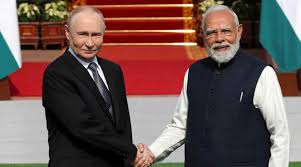
- Russian President Vladimir Putin arrived in India on 4 December 2025 for a two-day state visit.
- The visit is part of the regular cycle of annual bilateral summits between India and Russia — this is the 23rd India–Russia Annual Summit, alternating between the two countries.
- The formal invitation came from Narendra Modi, and the trip was confirmed by India’s Ministry of External Affairs (MEA).
- During this short visit, the aim is to review the full spectrum of bilateral ties — from defence, energy and trade to global geopolitical issues.
✅ Key Motives Behind the Visit
• Strengthening a “Special & Privileged Strategic Partnership”
- According to MEA, the summit “provides an opportunity … to review progress in bilateral relations, set the vision for strengthening the ‘special and privileged strategic partnership’ and exchange views on regional and global issues.”
- This is especially relevant because this is Putin’s first official visit to India since the outbreak of war in Ukraine in 2022
• Defence & Security Cooperation
- Defence ties are expected to be high on the agenda. Reports mention India’s potential procurement of additional long-range air-defence systems (e.g. S-400 air defence system) and possibly advanced jets like Su-57 stealth fighter.
- A recent Russian military delegation’s visit to Indian Army formations for “integrated safety and security of defence infrastructure” suggests ongoing close cooperation.
• Energy, Civil-Nuclear & Economic Cooperation
- Energy supply — especially oil — remains central. Given global tensions and pressure on countries to curb ties with Russia, continuing energy cooperation is significant.
- Civilian nuclear cooperation and other sectors (trade, industry) are also expected to be discussed.
- Both countries likely intend to sign multiple inter-governmental and business-to-business agreements, spanning public and private sectors.
• Global Geopolitics & Strategic Autonomy
- The visit occurs amid continued geopolitical tensions following the war in Ukraine, and under pressure from Western countries on India’s relations with Russia. Al Jazeera+2India Today+2
- By hosting Putin now, India reaffirms its independent foreign policy stance — signaling that despite global pressures, it values long-term strategic relation with Russia. India Today+2बिज़नेस स्टैंडर्ड+2
🕒 What’s on the Agenda – Key Events & Discussions
- On 5 December, Putin will be welcomed at the presidential palace for a formal ceremony including guard-of-honour, followed by a visit to Raj Ghat — the memorial of Mahatma Gandhi.
- The main bilateral talks will be held at Hyderabad House in New Delhi, where high-level discussions between Russian and Indian delegations will focus on defence, energy, trade, and broader strategic cooperation.
- Both state-level agreements and private-sector / business-level deals are expected — ranging from defence manufacturing, energy supply, joint ventures, and possibly in sectors like nuclear energy, infrastructure, agriculture, etc.
🔎 Significance — What’s at Stake for India and Russia
- For India, the visit means access to Russian defence technology and energy resources — crucial for national security and energy needs — especially at a time of global uncertainty.
- For Russia, strengthening ties with India helps maintain its global relevance, diversify its economic and strategic partnerships despite Western sanctions, and find reliable energy and defence partners.
- For the global geopolitical landscape, the visit signals that major powers like India are pursuing a “multi-aligned” policy — not strictly aligned to any bloc, but balancing relations with both Western and non-Western powers.
- Much also depends on the agreements signed — if major defence & energy deals get sealed, it could reshape regional power dynamics and trade/ defence-industry landscapes.
📝 What to Watch — Key Outcomes to Follow
- Will India place orders for additional S-400 systems or advanced Russian aircraft (e.g. Su-57)?
- Will there be major energy / oil supply commitments from Russia to India — particularly given global pressure on Russian oil trade?
- Will civilian nuclear cooperation (e.g. in nuclear power or technologies) see new agreements or revival/acceleration?
- What new trade / joint-venture deals — especially in non-defence sectors (industry, infrastructure, energy, agriculture) — will be announced.
- How the global reaction plays out — will this strengthen India’s strategic autonomy, or lead to friction with Western powers pushing against deep Russia-India ties.

